 Context Reader
What one study actually measured
Researchers took twenty real emergency-department discharge instructions, ran them through Google Translate into seven languages, and asked bilingual speakers one question about each: did the instruction still mean what it meant in English? Not "is it elegant" — does a patient reading this do the right thing.
Share of instructions whose meaning survived. Taira BR, Kreger V, Orue A, Diamond LC, A Pragmatic Assessment of Google Translate for Emergency Department Instructions, Journal of General Internal Medicine, 2021 — 400 judgements by 20 bilingual reviewers.
Two things stand out. Spanish is genuinely good. And the spread is enormous: the same tool, the same sentences, and Armenian readers got something usable barely half the time.
Why accuracy changes with the language
These systems learn from text. The more of a language exists online, translated alongside other languages, the better the system gets at it. Spanish, French, German, Portuguese and Chinese have oceans of it. Armenian, Farsi and most of the world's languages have far less, and the model has correspondingly less to go on.
It is not a judgement about the languages. It is a fact about how much of each one was written down where a machine could read it. Google has said its newer language support leans on large language models to bridge into languages closely related to ones it already knows, which helps — but it does not invent the missing text.
The errors that survive are the dangerous ones
You would expect the failures to look broken. Mostly they don't. In the same study, one Armenian translation offered a patient an anti-tank missile where the English said ibuprofen — obvious, and harmless because nobody would follow it. The quiet ones are worse. In an earlier study of the same kind of instructions, "hold the kidney medicine until you speak to your kidney doctor" came back in Chinese as "keep taking kidney medicine until you talk to your kidney doctor": fluent, confident, and the opposite of what the doctor meant.
That is the shape of machine-translation error. Not gibberish you can spot — a smooth sentence with one thing reversed.
Is Google Translate a dictionary?
No, and this is where most disappointment comes from. A dictionary lists every meaning a word has and leaves the choosing to you. A translator has to choose, and when you give it a single word there is nothing to choose from, so it returns the most common meaning. In a lab report, culture is a sample grown to find bacteria. Alone in a box, it is art and customs. The tool is not wrong about the word; it never saw your sentence.
How to check a translation when you don't know the language
hold the medicine
The sentence you actually need to understand.
→ your language
Whole sentence, never the single word.
keep taking it?
If you don't get your own words back, the meaning moved.
Back-translation is rough — a good translation can come back worded differently — but a reversed instruction almost always shows up. Two more habits that cost nothing: paste the whole paragraph rather than the sentence, and say out loud what the text is about before you trust the result, because most bad translations are a word pulled out of its field.
When not to rely on it at all
Anything you will act on: a dose, a deadline, a clause, a consent form. The study above was written precisely because hospitals were using machine translation with patients, and its authors' conclusion was not "don't" but "not on its own" — give the English alongside it, and use a human interpreter for anything that matters. The same logic covers contracts and immigration forms.
Where this leaves you, and where my extension fits
Translation is the right tool for a page you cannot read at all. For a page you can mostly follow, where one word stopped you, it is the wrong shape: you don't want the page moved into your language, you want that word explained in the sentence it is sitting in.
That is what Context Reader does — the free extension I build. Select the word and it sends the paragraph with it, then answers with the one meaning that fits, in your language. It is the difference between "what does this word mean" and "what does it mean here".
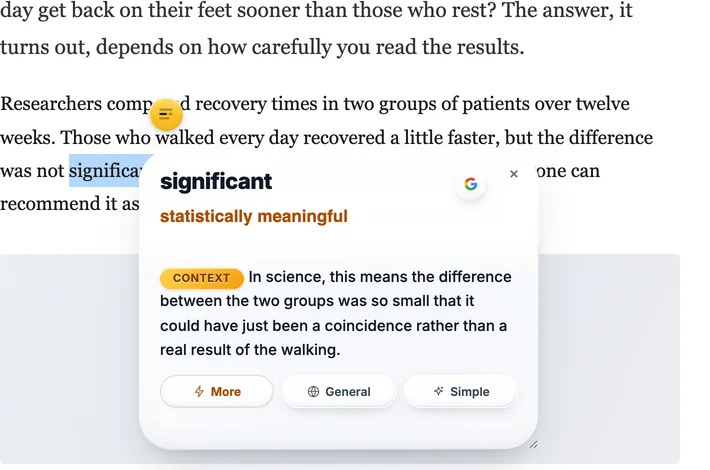
It has the same limits, honestly: the answers come from a model, only English and Sinhala ship examples checked by a speaker, and the EN button exists so you can see the same answer in English and catch a bad one. For a dose or a clause, ask a person.
Questions
Is Google Translate accurate?
For whole sentences between widely written languages, usually yes. In one study of emergency-department instructions it kept the meaning in 94% of Spanish translations and 55% of Armenian ones, and the errors that remained were the serious kind. Treat it as good for the gist and unreliable for a single word or a specialist term.
Is Google Translate accurate for my language?
It depends on how much text that language has online, because that is what these systems learn from. Spanish, French, German and Chinese do well. Smaller languages are noticeably weaker, and the same study found Armenian kept the meaning only about half the time.
Is Google Translate a dictionary?
No, and this is the most common mix-up. A dictionary lists every meaning a word has and lets you choose. A translator must choose for you, and with a single word it has no context to choose from, so it gives you the most common meaning.
Can I use Google Translate for medical or legal text?
For understanding roughly what a document is about, yes. For anything you will act on — a dose, a deadline, a clause — no. Two studies of medical instructions found rare but serious reversals, including a translation that told a patient to keep taking a medicine they had been told to stop.
How do I check a translation when I do not know the language?
Translate the result back into the language you started in. If the word that returns is not the word you began with, the meaning moved. It is rough, but it catches the obvious failures.
Sources
- Taira BR, Kreger V, Orue A, Diamond LC. A Pragmatic Assessment of Google Translate for Emergency Department Instructions. Journal of General Internal Medicine, 2021. The per-language figures in the chart.
- Khoong EC, Steinbrook E, Brown C, Fernandez A. Assessing the Use of Google Translate for Spanish and Chinese Translations of Emergency Department Discharge Instructions. JAMA Internal Medicine, 2019. The reversed medicine instruction.
- Google, 110 new languages in Google Translate, 2024, on using a large language model to reach related languages.
Related: why a single word comes back wrong, and how to understand English words when it isn't your first language.
Free. Chrome, Brave and Edge install from the Chrome Web Store; Firefox from addons.mozilla.org.