 Context Reader
The three passes
Is this for me?
Title, abstract, introduction, the section headings, the conclusion, and a glance at the references for names you know.
What did they find?
The figures and tables closely — axes, labels, error bars — skipping proofs. Mark references you will want later.
Is it right?
Rebuild the paper in your head: make the same assumptions and see whether you reach the same place. This is reviewer-level reading.
After the first pass you should be able to say what kind of paper it is, what it builds on, whether the assumptions look sound, what it claims, and whether it is well written. Keshav calls these the five Cs. If you cannot answer them in ten minutes, that is information too: either the paper is badly written or it is further from your field than you thought.
Timings from S. Keshav, How to Read a Paper, ACM SIGCOMM Computer Communication Review, 2007. The third pass is four to five hours for a beginner and about an hour for an experienced reader.
Why reading it straight through fails
A paper is not written in the order it should be read. The methods section is the hardest English in the document and is written for people repeating the work, not for people deciding whether to care. Start there and you will spend forty minutes on sample preparation before finding out the paper answers a question you did not have.
The real result is usually one figure or one table. Reading the caption and the axes tells you more in two minutes than the results section does in twenty, and figures are far easier to read in a second language than paragraphs are, because a chart is a chart everywhere.
If English isn't your first language, there is a fourth thing
The long technical words are the easy part. They mean one thing, and you look them up once. The trouble is ordinary words that a field has quietly borrowed.
| Word | What you know | What it means in a paper |
|---|---|---|
| significant | big, important | the result is unlikely to be chance — it can still be tiny |
| positive | good news | the thing was found; in a lab result, usually bad news |
| expression | a phrase, or a face | how much a gene is being used to make protein |
| regression | going backwards | a way of fitting a line to data |
| robust | strong | the finding holds up when the assumptions are changed |
| novel | a book | new — the paper's claim to be worth publishing |
These are the ones that change what a sentence means without making you stop. A result described as significant can be so small that nobody would ever notice it in a clinic; that is not a translation problem, it is a vocabulary problem hiding inside a word you already knew.
Where to find papers you can actually open
Before paying for anything: PubMed Central for biomedical work, arXiv for physics, maths and computing, and the preprint servers for most other fields. In Google Scholar, "All versions" under a result usually turns up a free copy, and many authors post the PDF on their own university page. If none of that works, the corresponding author's email is printed in the paper, and most researchers will send you their own paper if you ask — it costs them nothing, and they are pleased someone wants to read it.
When one word stops you
Two habits first, because they need nothing. Read one sentence further: papers define their own terms more often than you expect, usually immediately after the first use. And do not stop for every unknown word — only for the ones the paragraph depends on.
When you do stop, the thing you want is not a dictionary, which gives you every meaning, and not a translator, which has no context to work from when you hand it a single word. You want the meaning that fits this sentence.
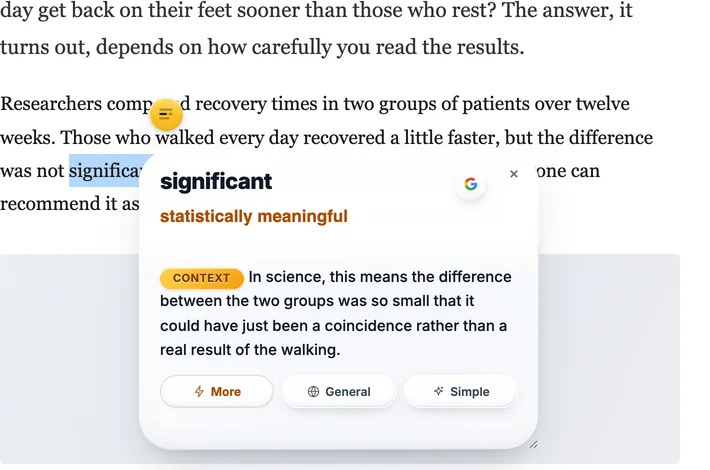
It works on journal sites, on PubMed and on a PDF open in your browser. The answers come from a model, so they can be wrong; the EN button shows the same answer in English, which is the fastest way to check one. For a dose or a clause, ask a person.
The part nobody says out loud
If a paper takes you an hour and you looked up nine words, you did not read it badly. You read it. Researchers reading in their own language do the same three passes, and they skip most of what they open. Speed comes from knowing the shape of papers and from deciding quickly what not to read — not from knowing more English.
Questions
How long does it take to read a research paper?
Ten minutes to decide whether it is worth reading, up to an hour to understand what it found, and four to five hours to understand it deeply enough to review it — about an hour if you already know the field. Those figures are from Keshav's three-pass method, which is the standard advice in computer science and travels well to other fields.
Which section should I read first?
The abstract, then the section headings and the conclusion. Then the figures. The methods come last, and often not at all: they are written for someone repeating the work.
Do I have to read the methods?
Only when you need to trust the numbers or repeat the work. For understanding what a paper found, the figures and the discussion carry it.
How do I read a paper when English is not my first language?
The same three passes, plus one thing: watch the ordinary words. Papers give plain English words field-specific meanings — significant, positive, expression — and those, not the long technical terms, are what change what a sentence means.
Where can I read research papers for free?
PubMed Central for biomedical work, arXiv for physics, maths and computer science, and the preprint servers for most other fields. Google Scholar shows free versions under “All versions”, and many authors post the PDF on their own university page. If nothing is free, the authors' email is in the paper and most will send you a copy.
Sources
- S. Keshav, How to Read a Paper, ACM SIGCOMM Computer Communication Review, 2007. The three passes, the five Cs and the timings.
Related: how to understand English words when it isn't your first language, and how accurate Google Translate is, language by language.
Free. Chrome, Brave and Edge install from the Chrome Web Store; Firefox from addons.mozilla.org.